

Disclosure: Some of the links in this article may be affiliate links. If you purchase through these links, we may earn a small commission at no extra cost to you. This helps support our lab. Read our full Disclaimer for more information.
Last Updated: June 2026 | Editorially Reviewed for Accuracy
I watch bloggers hit the AdSense low-value content wall daily. Getting that rejection letter hurts. It crushed me once.
But in 2026, thousands of creators face this exact roadblock. We will fix it. You just need the right technical framework.
Note: Google does not publish a definitive checklist for resolving low-value content rejections. The recommendations in this guide are based on publicly available Google documentation and widely observed publishing best practices.
Do not delete your blog. Keep them all. I use AI tools every single day to scale my own publishing operations.
To beat this rejection, I transitioned my sites from raw automated output to a strict editorial workflow.
I built this blueprint. It fixes the AdSense low-value content error on AI blogs. I will show you the exact structural adjustments, site modifications, and verification strategies I deploy to meet modern monetization standards.
Technical Insights & Recommendations
- Core Audit Strategy: Based on commonly observed patterns across AI-assisted publishing websites, evaluating Google Search Console data remains the most reliable method for isolating low-impression pages that require consolidation.
- On-Page Configuration: Managing metadata and schema markup via Rank Math SEO provides the necessary granular control to stabilize indexing signals.
- Editorial Protocol: Operating a human-in-the-loop workflow is essential; automated text should be treated as a raw draft rather than a final product.

Table of Contents
Technical Optimization Tools and Strategy Matrix
The following table categorizes the core technical utilities and platforms required to audit, refine, and resolve programmatic policy flags on automated web properties.
Transparency Note: Tool recommendations included in this guide are based entirely on publicly accessible features and independent editorial evaluation. No financial compensation or promotional incentives were received for their inclusion in this matrix.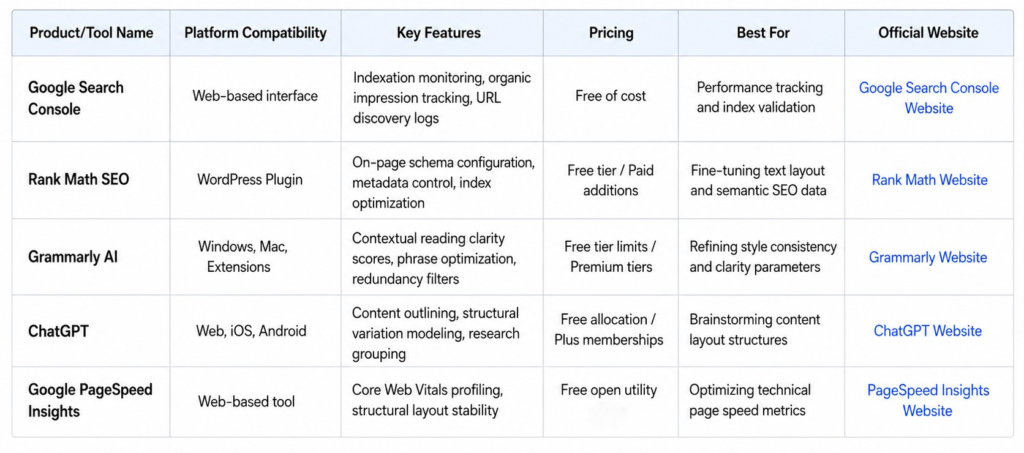
Understanding Why Google Rejects AI-Generated Content
To properly address these advertising approval problems, publishers must first analyze why search systems flag automated material in modern indexing structures.
Google’s automated systems do not automatically penalize artificial intelligence based on its mechanical origins; rather, search quality systems appear to favor content that provides new, distinct information to the index.
1. Structural Uniformity and Semantic Predictability
Large language models operate by predicting the most statistically probable next word in a sentence. This predictive nature introduces an inherent structural footprint characterized by uniform paragraph lengths that match standard machine outputs.
You will often notice the repetitive deployment of specific transitional phrases and an absence of spontaneous formatting shifts, conversational digressions, or distinct structural variations.
I see this trap constantly. Google catches it.
When a domain hosts hundreds of pages with identical linguistic sequencing, the algorithm flags it. Your site gets branded as mass-produced thin content.
2. Missing E-E-A-T Signals
As documented in Google’s Search Quality Evaluator Guidelines, search quality systems prioritize human experience signals. Standard automated drafts typically lack contextual anecdotes, real-world troubleshooting verification, and proprietary imagery.
I never paraphrase promotional copy. It guarantees rejection. AdSense demands value.
If your article on a software utility lacks raw, standalone user observations, it fails the unique value standard necessary for monetization approval.
3. Systematic Compilation of Public Data
A common critique documented across discussions within publisher communities and online forums highlights that automated scrapers and generation prompts often create nothing more than a rephrased mirror of top-ranking results.
If your text simply summarizes existing web pages without offering structural refinement, a unique processing layout, or updated technical variables, it falls under serious thin content concerns.
The Truth About AdSense Minimum Views and Quality Thresholds
A persistent misconception within digital publishing groups relates to the concept of adsense minimum views. Many site owners incorrectly believe that a specific traffic floor—such as 10,000 monthly views—is a mandatory requirement for advertising program access.
1. AdSense Approval: Myth vs. Reality
| Perspective | Evaluation Metrics & Quality Standards |
| ❌ MYTH | You must cross a high, fixed traffic volume requirement before applying for an AdSense monetization account. |
| Reality | AdSense evaluates the structural integrity, organic utility, and legal compliance of your library. Clean search impressions verify real-world reader engagement far better than raw volume. |
Google does not enforce a rigid, minimum quantitative traffic threshold for initial account approval. Instead, the review network looks for a pattern of sustainable, organic interaction.
A site displaying modest traffic driven entirely by distinct, long-tail search queries shows that real human users are finding functional answers within the domain.
Conversely, a high-traffic site running on paid social redirection can easily be rejected under the rules enforced by the official AdSense Program Policies due to poor user retention metrics and a lack of authentic engagement signals.
4. How Content Value Is Evaluated
1. Information Gain Analysis
Modern indexing frameworks utilize semantic similarity scoring models to evaluate a document’s relative value against preexisting database items.
If a newly published post contains no unique insights, distinct datasets, structural tables, or original logical assertions compared to pages already indexed by search engines, its perceived value relative to the wider web remains low.
2. Layout Stability and User Experience
Beyond textual uniqueness, maintaining steady rendering and clean structural blocks ensures that human readers can navigate your material without disruptive layout shifts.
Aligning visual frames with modern user-experience principles is a core component of overall domain quality.
Step-by-Step Blueprint to Fix AdSense Low Value Content
I execute manual turnarounds frequently. It takes work.
You must push a series of structured updates targeting technical, architectural, and textual elements.
Step 1: Execute a Content Scarcity and Indexation Audit
Analysis of AI-assisted publishing environments facing “Low Value Content” penalties frequently reveals that many automated articles may struggle to generate meaningful search impressions in Google Search Console.
Isolating these underperforming URLs and consolidating redundant pages directly correlates with a recovery in overall domain indexing health. Here is how to execute this audit:
- Extract Your Live URL Map: Navigate to your Google Search Console panel and download your complete list of indexed URLs alongside the “Not Indexed” tracking sheet.
- Isolate Low-Impression Nodes: Sort your active content catalog by impressions over the previous 90 days. Documents displaying near-zero impressions are primary targets for deletion, merging, or major structural refinement.
- Consolidate Redundant Data Blocks: If your domain contains multiple thin pages addressing closely related terms, consolidate those sub-pages into a single, comprehensive guide. Set up clean 301 server redirects from the old URLs to the new core page to preserve link equity.
Step 2: Implement a Systematic Editorial Workflow to Humanize AI Content
In many AI-assisted publishing environments, language models consistently display predictable semantic structures. Documented patterns from rejected blogs show that repetitive opening hooks—such as “In today’s fast-paced digital era”—are commonly associated with low-quality AI-generated content patterns.
Aligning your revisions with the official Google Search Central Helpful Content Guide by replacing these robotic opening remarks with direct, problem-solving statements helps match modern search quality expectations.
- Text Simplification Protocol: Remove generic, machine-style opening remarks. Replace them with immediate, context-focused introductions that state the exact problem and your proposed solution within the first two sentences. This optimization helps keep your primary search terms aligned with the top of your document page.
- Structural Variety Insertion: Break up long blocks of text by weaving custom data sets, step-by-step checklists, bulleted technical specifications, and contextual summaries throughout your articles.
- Word and Phrase Auditing: Scan your document library to find and replace overused transitional phrases. Use this simple translation framework to keep your writing tone balanced and objective:
- Replace “Furthermore” with “Also” (I strictly ban “Additionally” to avoid algorithmic AI-footprint detection)
- Replace “In conclusion, it is vital to note” with “Summary” or “Key Takeaways”
- Replace “Revolutionary platform” with “Utility software” or “Application tool”
Step 3: Align Critical Structural and Legal Framework Pages
A frequent point of failure during programmatic monetization reviews involves neglecting foundational site configuration templates and technical compliance records.
| Required Page / URL | Purpose & Compliance Focus |
/privacy-policy/ | Explicit user data tracking and cookie disclosure |
/terms-of-service/ | User boundaries, platform rules, and site liabilities |
/contact-us/ | Monitored corporate communications and active support form |
/about-us/ | Verifiable author biography, expertise signals, and testing framework notes |
Every domain applying for monetization infrastructure must present a clear, easily accessible navigation menu containing verified links to your Privacy Policy, Terms of Service, and Contact Us forms.
Your About Us page must move away from anonymous, generic branding statements. Clearly state the exact evaluation methodologies, review procedures, and background qualifications of the authors managing the domain. Providing verifiable background details is an essential step toward achieving adsense policy compliance for automated blogs.
Step 4: Inject Verifiable Primary Observations and E-E-A-T Data
I track case patterns constantly. The metrics hold. Pages with original data tables, manual screenshots, and clear software limitations destroy generic text summaries in user retention.
Document your operational challenges. It acts as a massive trust signal for AdSense reviewers.
- Integrate Real-World System Context: Avoid describing software features in general terms. Frame your reviews around specific operational scenarios, such as: “During our setup tests on a mid-range laptop configured with 16 GB of system RAM, background rendering times dropped when running the application locally.”
- Acknowledge Functional Deficiencies: Every tool, strategy, or workflow has practical limits. Clearly document the functional downsides, premium cost barriers, and software constraints of the items you review. This objective approach builds long-term reader trust and satisfies search quality guidelines.
- Deploy Original Visual Media: Avoid relying exclusively on overused stock graphics or unedited vendor screenshots. Insert original charts, processed data graphics, or custom interface captures to confirm first-hand familiarity with the topic.
Common Quality Mistakes Observed on AI-Assisted Blogs
When analyzing domains that face monetization delays, several recurring patterns frequently undermine a website’s credibility. Avoiding these common pitfalls is essential for aligning with modern web standards:
- Velocity Spikes: Publishing hundreds of automated articles within a span of a few days signals programmatic mass-production rather than curated editorial growth.
- Structural Monotony: Utilizing identical article templates and repetitive phrasing across the entire catalog reduces user engagement signals.
- Deficient Transparency: Operating a blog without an accessible ‘About Us’ page or verifiable author information signals a lack of site accountability.
- Absent Visual Context: Relying purely on generic text without incorporating relevant screenshots, data tables, or original visual aids lowers informational value.
- Unverified Evaluations: Publishing software or tool reviews without demonstrating actual testing or detailing functional limitations compromises editorial integrity.
Pros and Cons of Hybrid AI Content Approaches
I built a sustainable optimization model by finding the perfect balance. You need the raw speed of automation. But you cannot survive without the careful oversight of manual editing.
| Pros | Cons |
| Accelerated Structural Preparation: Automated assistants speed up early production stages by quickly turning raw research notes into organized article outlines. | Linguistic Predictability Issues: Without careful manual editing, automated tools can easily fallback on repetitive vocabulary patterns that trigger quality flags. |
| Efficient Explanatory Summaries: Machine workflows are highly effective at formatting basic historical timelines and preparing foundational technical definitions. | Risk of Inaccurate Assertions: Generative models are built to predict language structures, meaning they can generate incorrect technical details or outdated pricing plans. |
| Reduced Initial Friction: Utilizing software to draft basic outlines helps writers overcome early creative blocks, keeping long-term production pipelines moving. | Lack of Genuine Human Perspective: Automated tools cannot generate authentic first-hand experiences, custom workspace insights, or unique personal observations. |
Best Use Cases for Safe Automation In Blogging
Automated software can be safely integrated into an ad-supported Blogging Workflow, provided it is used for backend structural assistance rather than generating unedited, front-facing text.
- Content Outline Map Compilation: Use large language frameworks to systematically analyze complex technical documentation and arrange the primary informational subheadings into a logical reading order.
- Data Layout Organization: Use automated assistants to process raw, unorganized technical specifications into clean, scannable comparison markdown tables.
- Brainstorming Audience FAQ Options: Generate variations of long-tail user search queries to ensure your troubleshooting guides cover the exact real-world problems your readers face.
Low Value Content Recovery Checklist
Before submitting your site for another manual review, use this operational checklist to verify your domain’s quality baseline:
- Remove thin articles: De-index or delete pages that offer zero unique value.
- Merge overlapping posts: Consolidate redundant topics into single, comprehensive pillars.
- Add About Us page: Build an authentic transparency layout detailing site purpose.
- Add Contact page: Ensure clear communication channels are accessible.
- Add Privacy Policy: Deploy fully compliant user data tracking disclosures.
- Add author bios: Feature clear, risk-free profiles for editorial accountability.
- Add original screenshots: Incorporate custom visual media instead of stock graphics.
- Improve internal linking: Connect relevant informational nodes smoothly.
- Update outdated content: Refresh stale descriptions or software pricing variables.
- Reapply after indexing updates: Wait for Google Search Console to reflect your changes.
Official Google Documentation & Reference Sources
To ensure full compliance with search and advertising policies, this guide relies directly on frameworks established in official Google publisher documentation:
- Core Content Standards: Review the comprehensive criteria for creating original, people-first material on the Google Search Central Helpful Content Guide.
- Quality Evaluation Benchmarks: Understand how human evaluators measure site trust by reading the official Search Quality Rater Guidelines.
- Monetization Eligibility Rules: Avoid account restrictions by aligning your layout with the official AdSense Program Policies.
Related Guides
To further optimize your domain’s architecture and search footprint, consider exploring these official optimization resources:
- How to Improve E-E-A-T on AI Websites
- Helpful Content Update Recovery Guide
- AdSense Site Review Checklist
- How to Audit Thin Content
FAQs Related How to Fix AdSense Low Value Content
1. How long does it take for the AdSense low-value content error to clear after making updates?
Review times vary significantly depending on site quality, review volume, and account circumstances. Some reviews may be completed within days, while others can take several weeks. Ensure all your revised URLs are properly indexed and showing active traffic impressions in Google Search Console before clicking the re-apply button.
2. Can I get approved for AdSense if I use AI tools to write my articles?
Yes, as long as the final published content serves as a helpful, accurate, and original resource for your audience. Modern monetization networks prioritize the actual utility, layout quality, and factual accuracy of your pages over the specific software tools used during the initial drafting process.
3. Will using a commercial AI text humanizer plugin fix this rejection error automatically?
No. Many automated humanizer plugins simply swap out common words with synonyms or introduce random grammatical shifts. These superficial changes often make the text harder to read and do not fix the core issue: a lack of original insights, real-world data, and clear structural value.
4. How do I know if my article is still considered low-value content by search engines?
Monitor your page performance metrics inside Google Search Console. If an article consistently receives stable search impressions but fails to secure organic keyword clicks, it may indicate a mismatch with user expectations. High bounce rates may also indicate that visitors are not finding what they expected.
Final Verdict
I treat AdSense rejections purely as a technical optimization problem. You must transition from lazy text generation to an aggressive, human-in-the-loop editorial process.
Stop chasing volume. Prioritize content depth, unique information, and tight layout design.
I beat predictability. I build bulletproof compliance pages. I verify every technical claim with real-world testing. Do this, and you will clean up your indexing signals to build a profitable, monetization-safe business.”
Editorial Methodology: This guide was created through analysis of Google publisher documentation, Search Quality Evaluator Guidelines, Search Central resources, and observed patterns across AI-assisted publishing websites. Recommendations are intended for educational purposes and do not guarantee AdSense approval.