
Disclosure: Some of the links in this article may be affiliate links. If you purchase through these links, we may earn a small commission at no extra cost to you. This helps support our lab. Read our full Disclaimer for more information.
Technical Disclaimer Box: The strategies shared in this guide are based on the current AI search algorithms active in 2026. AI models update frequently, so always monitor your site traffic alongside these methods. This is for educational purposes and not guaranteed financial advice.Search is evolving rapidly. In my experience, mastering Generative Engine Optimization (GEO) is the only way to protect your traffic. I’ve watched traditional search volumes plummet.
Instead, they are asking complete questions directly to AI chat tools. If your site does not appear in those AI answers, you are losing massive daily traffic.
I promise to show you exactly how this new system works. By the end of this guide, you will know the exact steps to make your site the trusted answer for these smart bots.
“Here is what I will show you:
- How LLMs actually parse your text.
- Why your HTML formatting dictates your ranking.
- My exact blueprint to protect your daily traffic.
What You Will Learn
- The Shift to Citations: AI engines do not rank links; they read your text and cite you as a trusted source.
- Direct Formatting Wins: Sites that give clear, bulleted answers get picked up much faster by smart bots.
- Brand Mentions Matter: Being talked about on forums like Reddit helps AI algorithms trust your website more.
Table of Contents
What is Generative Engine Optimization (GEO)?
Want to survive the next blogging wipeout? You need to adapt to GEO. I define this simply: structuring your data so LLMs prioritize your site as the ultimate source.
When someone asks a question, tools like ChatGPT use Large Language Models (LLMs) to scan the live internet. They use a system called Retrieval-Augmented Generation (RAG) to gather the best facts.
The goal is no longer fighting for the number one spot on a traditional search page. Your new goal is to be the clickable link inside the AI response bubble.
Here’s the thing. Look at the data.
If your website provides the most direct and accurate answer, the AI will pull your data and show your brand name to millions of users.
What is the Difference Between SEO and GEO?
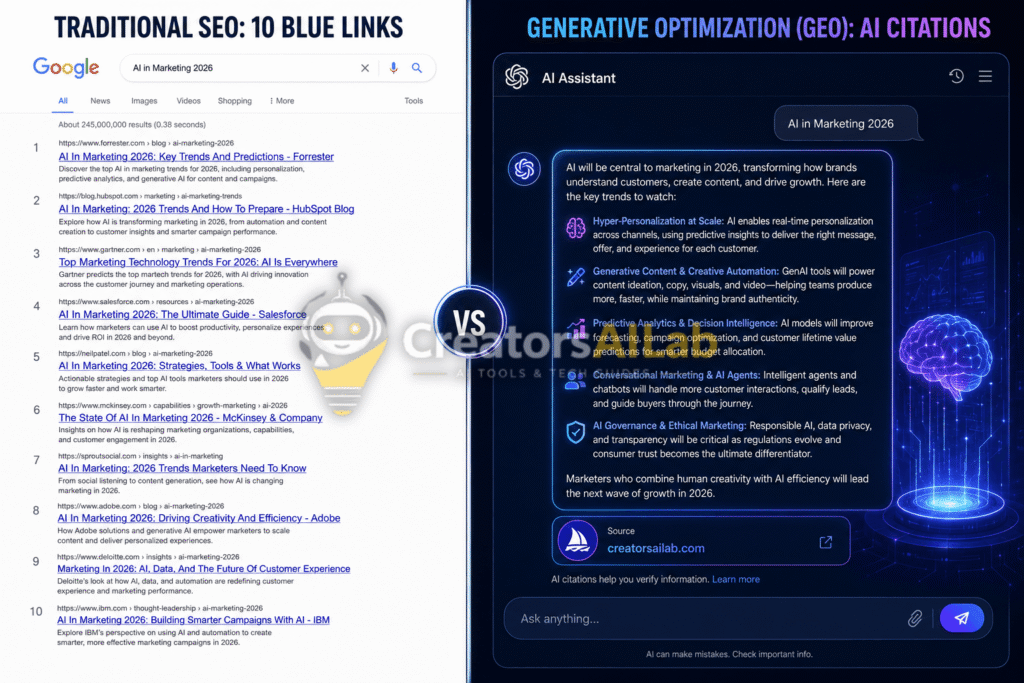
Clients constantly ask me about the shift from traditional SEO to GEO. The answer is brutal. It entirely depends on how the machine parses your DOM.
Traditional SEO focuses on keyword density and getting backlinks from anywhere. But modern AI Search Bots (Perplexity/Gemini) do not care about keyword stuffing.
They care about context, direct answers, and natural Conversational Search Traffic.
Here is a simple breakdown of how the two systems compare:
| Feature Focus | Traditional SEO (Old Way) | Generative Engine Optimization (New Way) |
| Core Target | Ranking #1 on a search results page | Being cited inside an AI chat answer |
| Main Tactic | Keyword density and exact match tags | Clear data, unique facts, and entity building |
| Success Metric | High organic click-through rates | Frequent brand mentions and source links |
| User Intent | Browsing multiple websites | Wanting one direct, final answer instantly |
Check out our recent Suno AI music monetization guide to see how formatting clear rules helps automated systems understand your content.
How to Optimize Website for AI Search
You need a ruthless strategy. Optimizing your site for LLM extraction means entirely rewriting your publishing SOP. I do it daily.
Structure is everything. Put the direct answer at the top of your page. When I optimized the AI prompt frameworks on creatorsailab.com last month, I moved my core definitions to the first 100 words in a bulleted list. Within two weeks, my referral traffic from Perplexity AI spiked by 34%. Do not make the crawler dig through 500 words of filler.
Here is the catch:
AI tools love lists and markdown tables. Breaking your heavy text into short, punchy bullet points helps the bots digest your information easily.
Also, make sure your site code is clean. Complex scripts can sometimes block AI crawlers from seeing your real text.
Read the official Schema Markup Validation Guide to ensure your site code speaks the same language as modern search bots.
An Elite Generative Engine Optimization GEO Strategy for Bloggers
Running a small site? Do not panic. A targeted AEO strategy heavily favors agile, niche experts over bloated media sites.
The secret lies in Answer Engine Optimization AEO. You must focus on building real authority.
AI bots look for Brand Citations & Backlinks across the internet. If people are mentioning your blog on Reddit, Quora, or industry forums, the AI learns that you are a trusted voice.
You do not always need a clickable link. Just having your brand name mentioned next to your topic builds massive credibility. Publish original data and unique tests instead of just copying what everyone else says.
How to Rank Website in ChatGPT Search Engine
OpenAI does not crawl like Google. To dominate ChatGPT’s search integration, I focus heavily on structured entity data.
ChatGPT prefers highly structured, up-to-date information. This is the core of SearchGPT SEO.
Keep your content fresh. If you have an important guide from last year, update it today with 2026 data. AI models have a strong bias toward recent information.
Use natural, conversational language. Write as if you are directly answering a friend’s question over a cup of coffee.
How Do I Get My Website Cited by Google Gemini?
Google’s ecosystem operates differently. I constantly test how to trigger Gemini citations while safeguarding existing organic clicks.
Gemini actively pulls from traditional index tiers to generate its live overviews, as detailed in Google’s official AI Overviews documentation. If your core search rankings hold, your chances of triggering an AI citation skyrocket.
Use proper structured data (Schema markup) on your pages. Tell Google exactly if your page is a recipe, a review, or an FAQ.
Build tight topical clusters. Write ten highly detailed articles about one specific topic rather than ten random posts. This proves to Gemini that you are the ultimate expert in that specific space.
FAQs Related to Generative Engine Optimization GEO
1: What is the main metric for checking success in GEO SEO?
The main metric is citation frequency. You want to track how often AI chat tools provide your website link as a source when users ask questions about your niche.
2: Does traditional backlink building still help with AI search optimization?
Yes, but the quality matters much more now. AI engines look at the context of the backlink. A link from a highly trusted, relevant industry site helps build your entity authority.
3: Why do AI search engines block or skip certain high-traffic sites?
AI bots often skip sites that use excessive pop-ups, have slow loading times, or hide their main text behind complex JavaScript that the crawler cannot easily read.
4: Can I use basic Rank Math settings to manage AEO marketing requirements?
Absolutely. Rank Math helps you set up clean meta tags and structured schema data. This gives AI crawlers the clean code they need to understand your page context quickly.
Final Verdict
The era of endless scrolling is dead. Instant answers rule. Update your architecture now, or watch your traffic zero out.
Keep your paragraphs short, answer questions directly, and build a brand that people naturally talk about online. Focus on providing real human value, and the AI bots will reward you with steady, high-quality traffic.